
Designing a dual-motion GTM and halving the cost of growth
GTM Strategy • PLG • ABM • ICP • Pricing • Market Expansion
CASE STUDIES
7/14/20262 min read
The result was a significantly more efficient growth engine, reducing CAC payback from 15 months to 8, increasing trial-to-paid conversion to 40%, achieving 52% overall PLG conversion, generating £93K from a £15K ABM investment, and tripling monthly free trials.
What Changed
Growth no longer depended on increasing acquisition spend. The company gained two complementary commercial motions, each supported by a single operating model, enabling Marketing and Sales to acquire different customer segments without duplicating infrastructure or commercial effort.
Commercial Outcomes
Business Performance
CAC payback reduced from 15 months to 8 months
Trial-to-paid conversion increased to 40%
Overall PLG conversion reached 52%
Enterprise ABM generated £93K from a £15K investment
Monthly free-trial volume increased from 40 to 120
Organisational Impact
Marketing investment became directly aligned with commercial outcomes
One commercial operating model supported both self-serve and enterprise buyers
CRM and lifecycle reflected customer behaviour rather than internal processes
Marketing and Sales operated under a single shared acquisition strategy
Strategic Decisions
The redesign centred on simplifying the commercial model around customer behaviour rather than organisational structure.
The programme focused on:
Defining separate ICPs for self-serve and enterprise customers
Designing a dual-motion GTM combining PLG and enterprise ABM
Rebuilding CRM and lifecycle automation around buying behaviour
Reallocating marketing investment away from low-performing channels
Discontinuing Meta lead generation and gated content in favour of product-led acquisition
Influencing pricing models and defining pricing for Poland and Germany
Aligning Marketing and Sales around one commercial acquisition framework
The Commercial Challenge
Customer acquisition depended on a single sales-led motion that became increasingly expensive as the company grew. Self-serve buyers followed a fundamentally different purchasing process from enterprise customers, yet both were expected to move through the same commercial journey.
Marketing activity generated demand, but investment decisions were largely disconnected from commercial outcomes. Pricing lacked consistency across markets, lifecycle communications were underdeveloped, and acquisition channels that delivered activity rather than revenue continued to receive budget.
Executive Summary
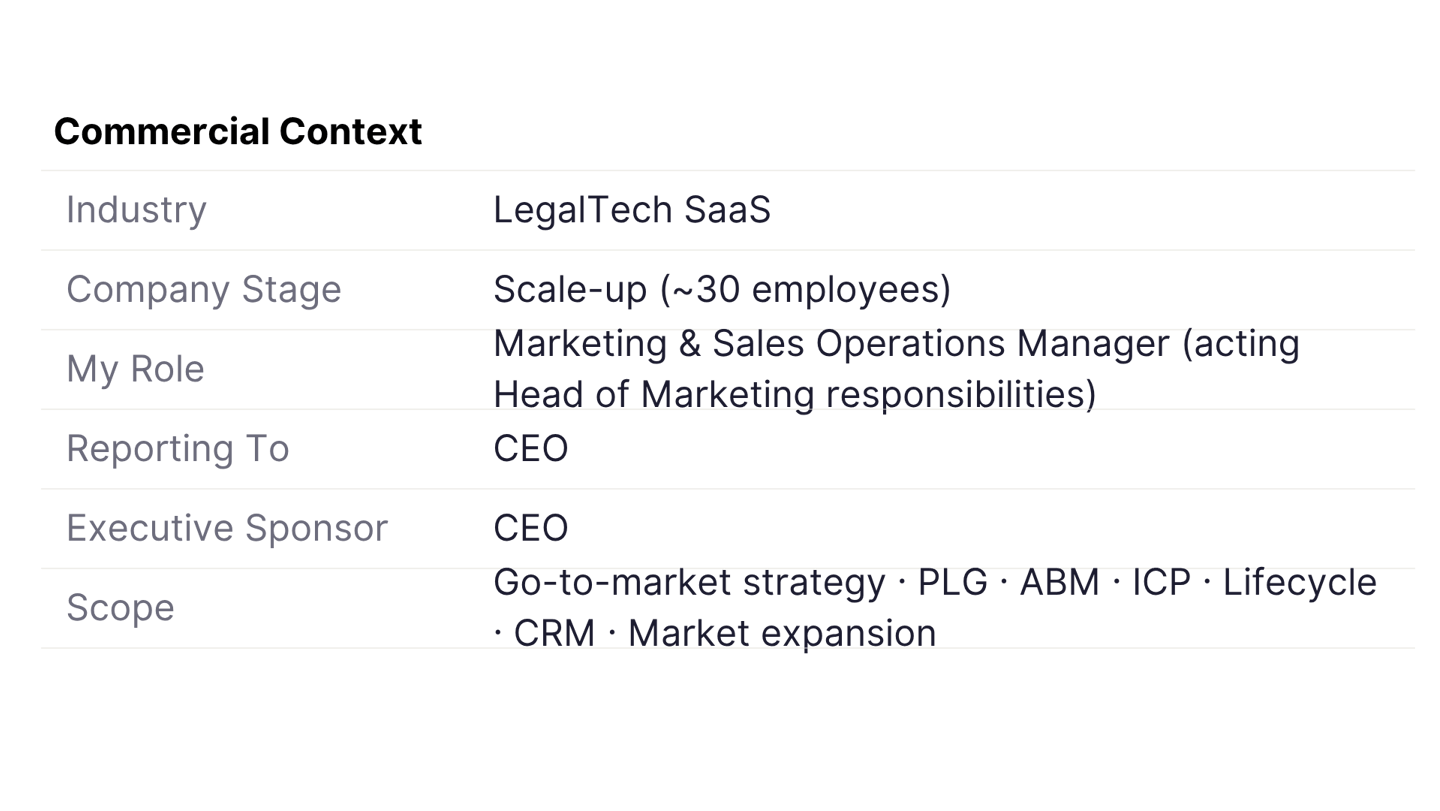
The business relied almost entirely on an expensive sales-led acquisition model that limited growth and extended customer acquisition costs. Reporting directly to the CEO, I redesigned the commercial model around two distinct buying journeys, combining product-led growth for self-serve customers with account-based marketing for enterprise buyers.
Rather than adding new channels, the focus was on aligning positioning, customer acquisition, lifecycle, CRM and commercial investment around how different customers actually bought the product.
My Role
Reporting directly to the CEO, I was responsible for redesigning the commercial model that supported marketing, sales, and customer acquisition.
My role covered GTM strategy, CRM, lifecycle marketing, customer communications, budget allocation, ICP definition, PLG implementation, enterprise ABM, commercial reporting and international market expansion. I also led an internal marketing team while working closely with Product, Customer Success and Sales.