
Leading growth and digital marketing through an operating model transition
Enterprise IT and software engineering firm · Digital Marketing and Operations · Team management · Budget allocation · Growth Marketing
CASE STUDIES
7/14/20263 min read
Executive Summary
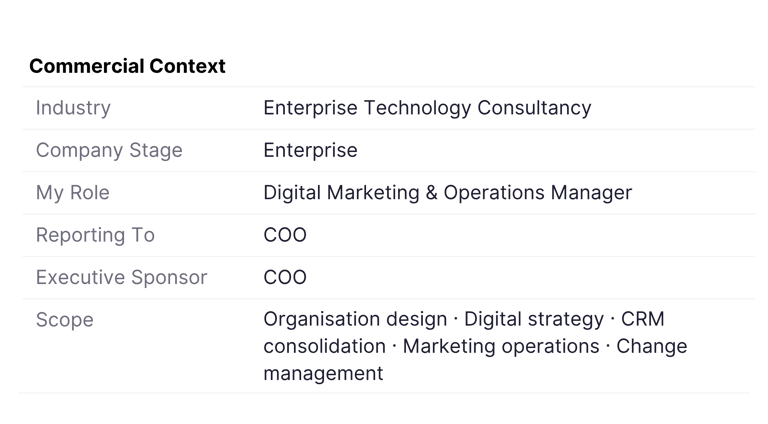
I owned growth and digital marketing across four global regions, the advertising budget, campaign orchestration, the CRM, and the nurture engine, while the marketing function was restructured around it. The COO set the direction based on what I built, the operating structure that made it executable, and kept growth running through the transition. The result was a 15% uplift in sales-qualified leads and a 47% gain in engagement, delivered by a smaller function than the one it replaced, and, moreover, aligned marketing with commercial priorities while simplifying processes, technology, and team responsibilities.
My Role
Working directly with the COO, I supported the operational design and implementation of the new marketing model. At the same time, I led growth and digital marketing across EMEA, North America, APAC, and LATAM. I set the digital channel strategy, including content; owned an advertising budget of approximately £100K and allocated it by region and channel; orchestrated the campaigns that ran on it; and owned the CRM, lead management, and nurture engine underneath. I led a team of five across web, content, and paid media.
Commercial Outcomes
Business Performance
Sales-qualified leads increased by 15%
Engagement increased by 47% across four global regions
Account-level attribution built from scratch in a new stack, giving the business its first view of campaign contribution across whole buying groups.
A function of fifteen outperforms the twenty it replaced, with the capability moved to where it structurally belonged rather than being cut
Organisational Impact
Marketing shifted from siloed specialist teams to a connected operating model
Commercial business units received consistent strategic marketing support
Technology, reporting and digital execution became standardised across the organisation
Marketing delivered greater commercial impact with fewer duplicated resources
The Commercial Challenge
Marketing capability had evolved around functional expertise rather than business needs. Teams operated independently, digital platforms lacked consistency, and commercial business units received different levels of marketing support depending on internal structures rather than customer priorities. The CMO left, taking five people with her, leaving fifteen in a generalist function siloed from the commercial verticals it was meant to support, with duplicated capabilities and a scattered stack. The organisation needed a scalable model that could support multiple business verticals without increasing operational complexity, and continuous growth.
Strategic Decisions
I defined the ICPs that made the vertical alignment coherent, because a function aligned to five markets has to know precisely who each one sells to. I discontinued the large volume of gated content that did not work for the model, refocusing on a steady blog and social presence that did. I led the migration to Marketo and Salesforce and built account-level attribution from scratch in the new stack, so campaign contribution could be read across entire buying groups rather than individual contacts. And I decided where the regional budget went and what it was for.
Supporting the operating model transition
The COO set the direction and introduced a skills matrix approach. My part was to translate it into a structure that could work in practice. I mapped with HR what could move where, based on what people could do and what they wanted to do, and designed the model that followed: five product marketers became vertical marketing partners supporting the commercial departments directly, employee advocacy moved to People Ops with its own budget rather than draining marketing's, visual media and video moved to the in-house design team, and comms consolidated to one senior brand and PR lead I worked closely with. The board approved the model. The COO and HR ran the conversations with the team. Afterwards, I worked with each team on the setup and coordinated delivery across HR, the COO, and the teams themselves.
What Changed
Rather than adding more capability, the organisation achieved better commercial performance by redesigning how existing capabilities worked together. Marketing became aligned with business priorities rather than organisational history. Growth kept running through a restructuring and came out on a model built around what people could actually do, with the measurement to prove what worked.