
Leading GTM and Revenue Marketing for a Scaling SaaS
Acting Head of Marketing · Dual-Motion GTM · PLG · Enterprise ABM · ICP · Pricing · Market Expansion
CASE STUDIES
7/14/20263 min read
What Changed
The company left this phase with a clearer way to acquire and progress both self-serve and enterprise customers without running two separate Marketing functions.
Sales and Marketing worked from the same ICP and acquisition strategy, while lifecycle and CRM reflected the different ways those customers bought.
Marketing performance also became easier to judge commercially: leadership could compare spend, acquisition efficiency and revenue contribution rather than relying primarily on activity metrics.
The model provided a repeatable base for further market expansion rather than requiring the acquisition approach to be rebuilt for each new geography.
Commercial Outcomes
CAC payback reduced from 15 months to 8 months
Monthly free-trial volume increased from 40 to 120
Trial-to-paid conversion reached 40%
Overall PLG conversion reached 52%
Enterprise ABM generated £93K from a £15K investment
The company expanded into two new European markets
Strategic Decisions
I set the ICP, clarifying which customers the company was building and selling for, and influenced the broader pricing model. When we launched in Poland and Germany, I set pricing for those markets as part of the GTM work.
I owned the full Marketing budget of approximately €100K and reported spend efficiency directly to the CEO. As the performance data became clearer, I stopped investing in activity that generated volume without enough commercial return, including Meta lead generation and gated content, and shifted budget toward the channels and motions that were converting.
The most important structural decision was separating the two buying journeys without creating two disconnected commercial organisations. Product-led growth gave self-serve customers a low-friction route to purchase, while enterprise ABM created a more deliberate path into Sales for larger accounts. I worked with the Chief of Business Development to connect that motion to the Sales process.
I rebuilt the CRM and lifecycle around those journeys so the commercial system reflected how customers actually bought.
The Commercial Challenge
The company was acquiring customers at a high cost through a largely sales-led motion, with a CAC payback period that put pressure on a ~30-person business.
At the same time, the company was serving two groups with very different buying behaviour. Smaller customers wanted to discover and evaluate the product themselves. Enterprise deals involved multiple stakeholders and required a longer, coordinated process.
Marketing was generating demand, but investment decisions were not consistently tied to commercial outcomes. Pricing varied across markets, lifecycle communications were still developing, and some channels continued to receive budget despite generating activity without enough revenue.
The challenge was to support both buying motions within one commercially viable model and create a foundation the company could use as it expanded.
Executive Summary
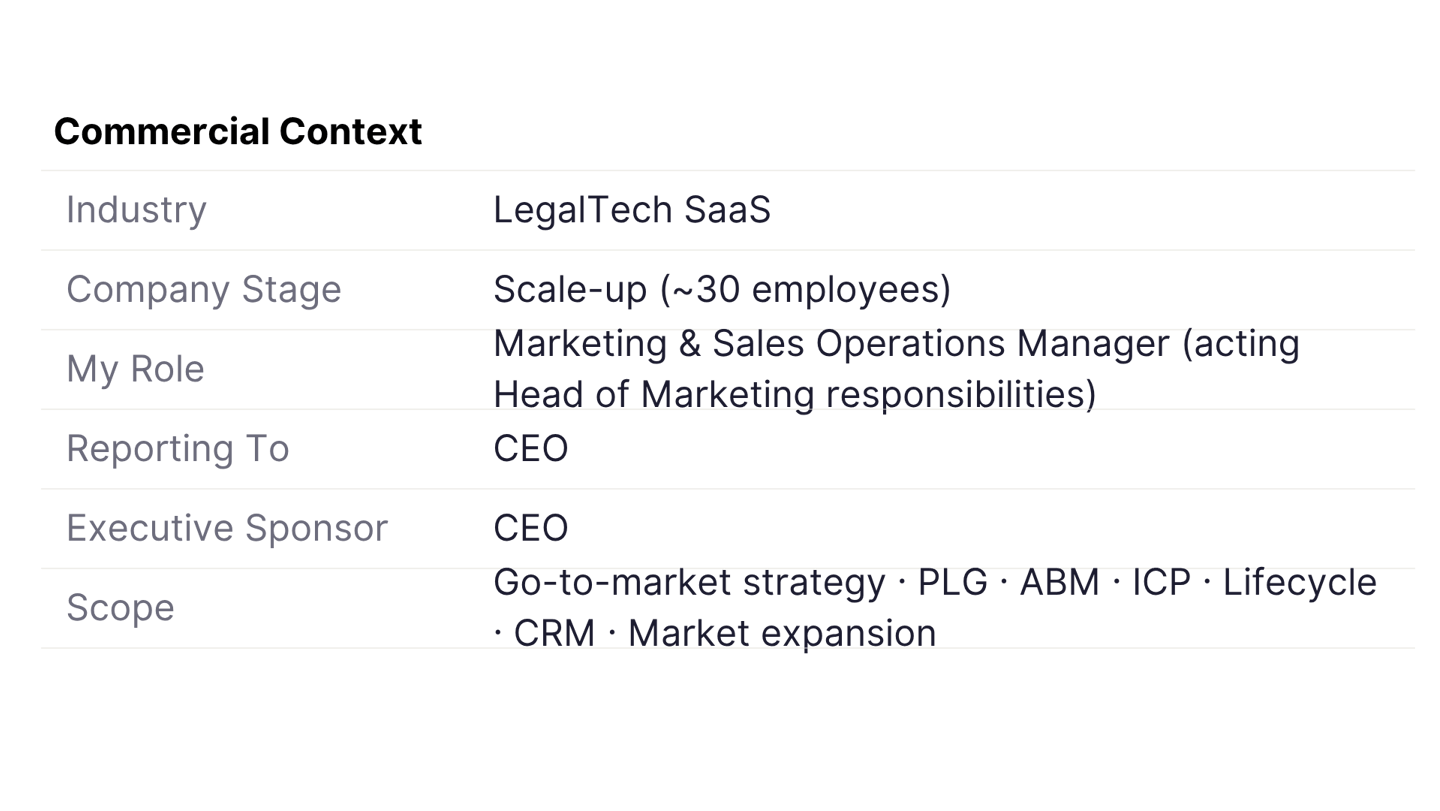
I served as Acting Head of Marketing for a scaling legal-tech SaaS, reporting directly to the CEO and owning the strategy, budget, team and the commercial decisions behind how the company went to market.
The business was serving two very different buyers: self-serve customers who wanted to evaluate the product independently, and enterprise buying committees that needed a more structured sales process. I designed a dual-motion GTM model that combined product-led growth with account-based marketing, while keeping both motions within one commercial system.
I set the ICP, influenced positioning and pricing, launched the product into two new European markets, and rebuilt the lifecycle and CRM around how each buyer actually moved. The model tripled monthly trial volume, sustained 40% trial-to-paid conversion and reduced CAC payback from 15 to 8 months.
My Role
As Acting Head of Marketing, I led the marketing function and worked directly with the CEO on GTM strategy, acquisition economics and growth priorities.
I owned the Marketing budget, team and operating model, with responsibility across ICP definition, product-led growth, enterprise ABM, lifecycle, commercial reporting, pricing input and international market expansion.
I managed the in-house team across web development, paid search and social, alongside freelancers and agencies, and worked cross-functionally with Sales, Customer Success and Product.
Because the commercial infrastructure needed to support the model as well as the campaigns, I also rebuilt the CRM and customer lifecycle used by Sales and Customer Success.

