
Redesigning commercial operations to improve pipeline performance
GTM function · Marketing Operations · Marketing Leadership · Operating model redesign · Attribution · Project management
CASE STUDIES
7/14/20262 min read
Executive Summary
I built a marketing operations system that then beat its pipeline target every completed quarter of my tenure, peaking at 164%.
The starting point was that pipeline generation lacked consistency, lead quality was continually questioned by Sales, and leadership had no reliable way to understand which commercial activities generated revenue.
The lasting outcome was a commercial engine that leadership could measure, trust, and forecast. I was brought in by the COO to rebuild it, and built it to keep performing.
My Role
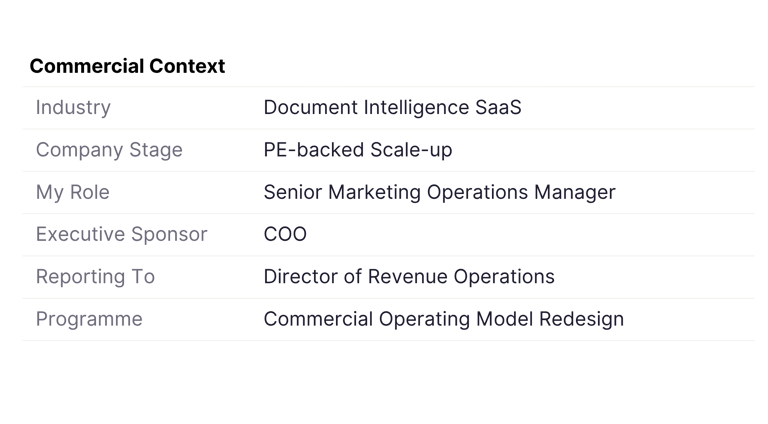
I led marketing operations within the revenue operations function, redesigning the operational model and defining the strategy, plan, and team deployment, with direct reports across web marketing, paid media, development, and tech stack analysis, plus a data analyst supporting sales and marketing.
What changed
A function that had produced nothing measurable became one that beat its number every completed quarter of my tenure - blind spots for inbound and outbound activities were removed, and marketing started to be recognised for contributing to the pipeline rather than draining budget. The point was not a one-time fix but a system that kept performing: repeatable pipeline leadership could forecast on, quarter after quarter.
The Commercial Challenge
Marketing worked hard to generate engagement and produce valuable content that drove activity, but could not demonstrate full commercial value, with many blind spots in lead management and attribution tracking.
Lead qualification and nurturing varied across acquisition channels. Handover to the BDR team was inconsistent, and attribution rewarded only the beginning and end of the customer journey. Moreover, executive reporting failed to explain why opportunities were converted or not.
The organisation lacked a marketing infrastructure aligned with its commercial operating model. Marketing, Sales, and Revenue Operations operated in silos. The underlying systems had been left to accumulate debt rather than be maintained.
The marketing automation platform and CRM were connected, but the MAP had been left unmaintained for a long time, and successive issues had been patched rather than fixed at the root cause. Tooling was scattered across the function, with little communication among the people running it, so tracking and attribution were unreliable. There was no reporting leadership could use, no structured lead handover between marketing and the BDR team, and no nurturing to keep leads active. The pipeline was, in general, disconnected from the activity meant to produce it.
Strategic Decisions
I restructured the function into a single, connected system rather than a set of disconnected tools. I consolidated a fragmented stack onto a single operating platform that the team could actually run. I rebuilt attribution from two-touch to multi-touch, bringing the mid-funnel and outbound contribution that had been invisible into the measured picture. I built the lead-handover and routing layer between marketing and the BDR team, which had never existed before. I added automations for core marketing functions to manage leads smoothly and enable cross-nurturing to keep leads active. Lastly, introduced AI-assisted lead scoring to prioritise them.
Commercial Outcomes
Business Performance
Pipeline creation exceeded the target every completed quarter, peaking at 164% (~$10.1M against a ~$6.2M target).
Company Subscription ARR reached 140% of the quarterly target during the assessed period.
Speed-to-lead reduced by 20% during the first month after implementation.
Organisational Impact
Marketing, Sales, and Business Development adopted a single connected lead management process.
Leadership gained reliable attribution and commercial reporting.
Marketing became accountable for a measurable pipeline rather than campaign activity.
Commercial investment decisions could be made using trusted data rather than assumptions.