
Redesigning Global Marketing Around Commercial Priorities
Global Growth · GTM Operating Model · Organisation Design · Digital Marketing · Measurement
CASE STUDIES
5/13/20243 min read
Executive Summary
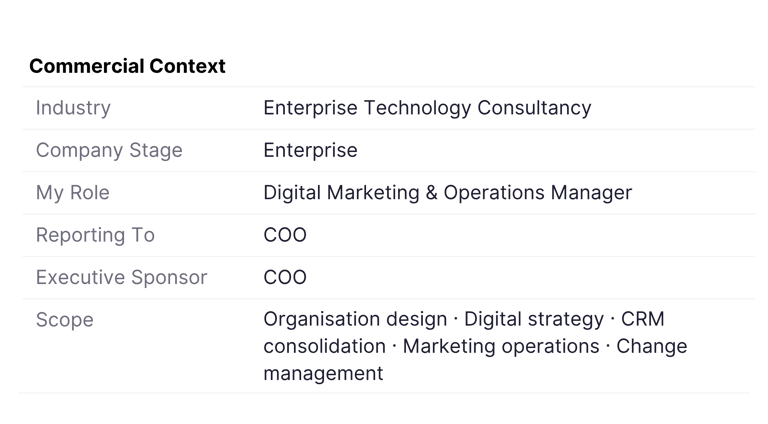
I led growth and digital marketing across EMEA, North America, APAC and LATAM while the Marketing organisation was being restructured around a new operating model.
Working directly with the COO, I helped translate the new organisational direction into a structure that could work in practice: aligning Marketing more closely to commercial verticals, moving specialist capabilities to the teams best placed to own them, and standardising the digital, CRM and measurement infrastructure underneath.
At the same time, I remained responsible for global digital growth, budget allocation, campaign orchestration, CRM, lead management and nurture.
During the transition, sales-qualified leads increased by 15% and engagement by 47%, while the new 15-person structure delivered stronger commercial outcomes than the 20-person model it replaced.
My Role
I worked directly with the COO on the operational design and implementation of the new Marketing model while continuing to lead growth and digital marketing across four global regions.
I owned digital channel strategy, including content, and an advertising budget of approximately £100K, which I allocated by region and channel. I also owned CRM, lead management and nurture, and led a five-person team across web, content and paid media.
My role in the organisational transition was to help turn the proposed direction into a structure the existing teams could actually operate.
Commercial Outcomes
Sales-qualified leads increased by 15%
Engagement increased by 47% across four global regions
Account-level attribution was built in the new Marketing and CRM stack
The new operating model delivered stronger commercial outcomes through clearer ownership, better alignment and a more coherent team structure
Commercial Challenge
Marketing capability had grown around functional expertise rather than the business's commercial structure.
Teams operated independently, digital platforms and processes lacked consistency, and commercial business units received different levels of Marketing support depending on where capability sat internally.
When the CMO left, five people left with her. The remaining 15-person function was still largely organised as a generalist Marketing department, while the wider business was increasingly operating through distinct commercial verticals.
The company needed a model that could support those verticals more consistently without rebuilding a larger central Marketing function, while continuing to generate growth during the transition.
Strategic Decisions
The first step was defining the ICPs for the commercial verticals. If Marketing was going to align more closely to the business units, each one needed a clear view of who it was selling to.
I then worked with HR to map existing capability against the new structure: what people were good at, where those skills created the most value, and where responsibilities had become duplicated or sat in the wrong part of the organisation.
That led to a different allocation of capability. Five product marketers became vertical Marketing partners supporting the commercial departments directly. Employee advocacy moved into People Operations with its own budget. Visual media and video moved into the in-house design team. Communications was consolidated under one senior Brand and PR lead.
The COO and HR led the formal people process and the board approved the structure. I then worked with the teams on the new setup and coordinated delivery across Marketing, HR and the COO.
At the same time, I continued to make the commercial decisions behind digital growth. I discontinued the large volume of gated content that was not performing for the model, refocused effort on the channels generating stronger engagement, led the migration to Marketo and Salesforce, and built account-level attribution so campaign contribution could be read across buying groups rather than individual contacts.
What Changed
Marketing became more closely aligned with the business's commercial structure rather than remaining organised primarily around specialist functions.
Commercial verticals received more consistent Marketing support, while capabilities such as advocacy, design and communications sat in the teams best placed to own them.
Digital execution, CRM and measurement also became more standardised across the organisation.
The transition happened without pausing growth. The function continued to improve commercial performance while reducing duplicated capability and creating clearer ownership across the organisation.

