
Restructuring a marketing organisation around commercial priorities
Enterprise IT and software engineering firm · Digital Marketing and Operations Manager · commissioned by the COO
CASE STUDIES
7/14/20261 min read
Executive Summary
The organisation had outgrown its marketing structure. Independent specialist teams operated in silos, duplicated capability and lacked consistent support for the commercial business units they served.
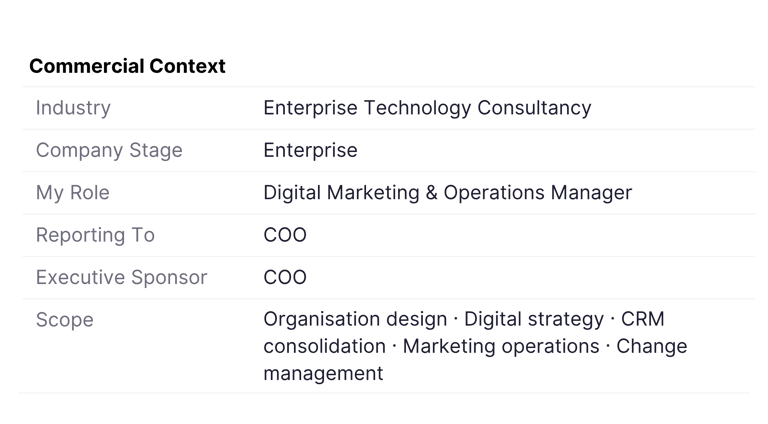
Commissioned by the COO, I translated a high-level restructuring strategy into a practical operating model that aligned marketing with commercial priorities while simplifying processes, technology and team responsibilities.
My Role
Working directly with the COO, I led the operational design and implementation of the new marketing model. My responsibilities included digital strategy, organisational redesign, CRM consolidation, marketing technology, content strategy, reporting, stakeholder alignment, and implementation planning, while managing an internal team and coordinating change across multiple business units.
Commercial Outcomes
Business Performance
Sales-qualified leads increased by 15%
Engagement increased by 47% across four global regions
Organisational Impact
Marketing shifted from siloed specialist teams to a connected operating model
Commercial business units received consistent strategic marketing support
Technology, reporting and digital execution became standardised across the organisation
Marketing delivered greater commercial impact with fewer duplicated resources
The Commercial Challenge
Marketing capability had evolved around functional expertise rather than business needs. Teams operated independently, digital platforms lacked consistency, and commercial business units received different levels of marketing support depending on internal structures rather than customer priorities. The organisation needed a scalable model capable of supporting multiple business verticals without increasing operational complexity.
Strategic Decisions
The programme focused on simplifying the organisation around commercial priorities.
The work included:
Redesigning the organisational structure around business verticals
Introducing marketing partners supporting specialised commercial markets
Centralising digital marketing onto one CRM and operating structure
Leading migration onto Marketo and Salesforce
Implementing account-based attribution across complex buying groups
Simplifying content strategy by removing ineffective gated content
Separating employee advocacy from marketing to improve budget efficiency
What Changed
Rather than adding more capability, the organisation achieved better commercial performance by redesigning how existing capabilities worked together. Marketing became aligned with business priorities rather than organisational history.
The restructured function delivered a 15% increase in sales-qualified leads, improved engagement across four global regions by 47%, and created a leaner organisation capable of supporting future growth.