
The First Structured Marketing Function for an Early-Stage SaaS
Marketing Strategy · Demand Generation · CRM · Lead Management · Commercial Infrastructure
CASE STUDIES
7/14/20262 min read
Executive Summary
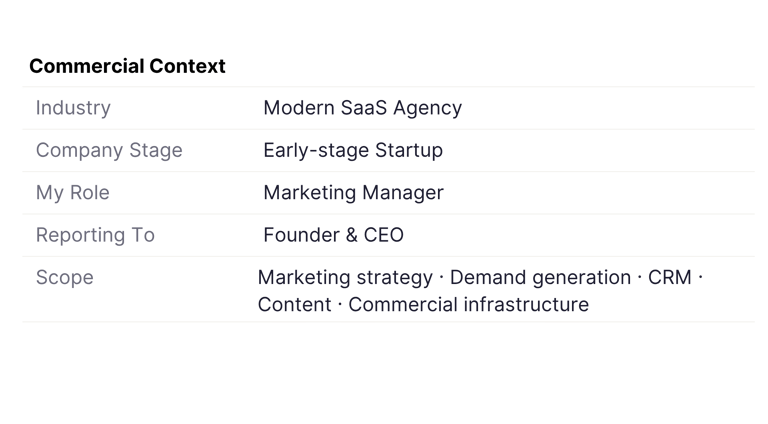
I worked with the founders of an early-stage SaaS business to establish its first structured Marketing function.
Growth had relied heavily on founder relationships and reactive acquisition activity, with little infrastructure to manage leads, measure performance, or connect marketing activity to commercial outcomes.
I introduced the first Marketing strategy, CRM and lead-management processes, demand-generation programmes and commercial reporting, creating a foundation the business could continue to develop as it grew.
My Role
I established the company's first structured Marketing capability, working directly with the founders and leadership team.
I defined marketing priorities, introduced supporting systems, and created repeatable acquisition and lead-management processes.
The remit covered Marketing strategy, demand generation, CRM, reporting, lead tracking and alignment with Business Development.
Commercial Outcomes
Established the company's first structured demand-generation capability
Introduced CRM-based lead management and acquisition tracking
Connected Marketing activity to Business Development follow-up
Introduced reporting on lead source, quality and commercial progression
Created a repeatable Marketing process that could continue as the business grew
The Commercial Challenge
The company had reached the point where founder-led acquisition alone was no longer enough.
Marketing activity was reactive, customer acquisition lacked consistency, and little formal infrastructure supported the commercial process. Lead sources were difficult to track, reporting was limited, and there was no common process for managing leads from initial engagement through to Business Development.
The company was also reviewing how it measured and rewarded outbound activity. The existing approach placed too much emphasis on the number of contacts reached rather than the quality of opportunities created and their eventual contribution to revenue.
The immediate challenge, therefore, was not simply to generate more leads. It was to give the business its first workable Marketing and lead-management structure.
Strategic Decisions
I started by defining what Marketing needed to own and how it should support the company's commercial priorities.
I introduced a CRM and a structured lead-management process so acquisition activity could be tracked beyond the initial interaction and carried through to Business Development.
I established the first repeatable demand-generation programmes and connected them to a clearer follow-up process rather than treating individual campaigns as standalone activity.
I redesigned reporting around lead source, quality, and commercial progression so leadership could see which activity was producing useful opportunities.
I also worked on the measurement behind outbound activity, moving the focus away from rewarding outreach volume alone and towards the quality of leads that progressed and generated revenue.
Where needed, I reviewed outreach processes to make sure the new model could operate within the company's compliance requirements.
What Changed
Marketing became a defined business function rather than a collection of ad hoc activities.
The founders gained a clearer view of where leads came from, how they progressed and which activity was producing commercially useful opportunities.
Marketing and Business Development also had a more consistent process for lead management and follow-up, while CRM and reporting provided infrastructure the company could build on as acquisition became more sophisticated.
The biggest change was that growth no longer depended entirely on knowledge sitting with the founders. The commercial process had started to become visible, documented and repeatable.

